Seiko 7A38 - by the numbers
Subtitle
Forums
| Forum Home > Bend it, Mend it - Mods & Wreckers > B.A.D. 7A38 movement - back from the brink. Well, maybe part way, anyway .... | ||
|---|---|---|
 Site Owner Posts: 14428 |
For the benefit of those readers whose first language isn't English, I'd better explain what a Rountuit (Round-tu-it / Round Tuit) is. It's one of these. Take your pick: http://www.google.co.uk/search?q=round+tuit They come in lots of different designs and diameters.
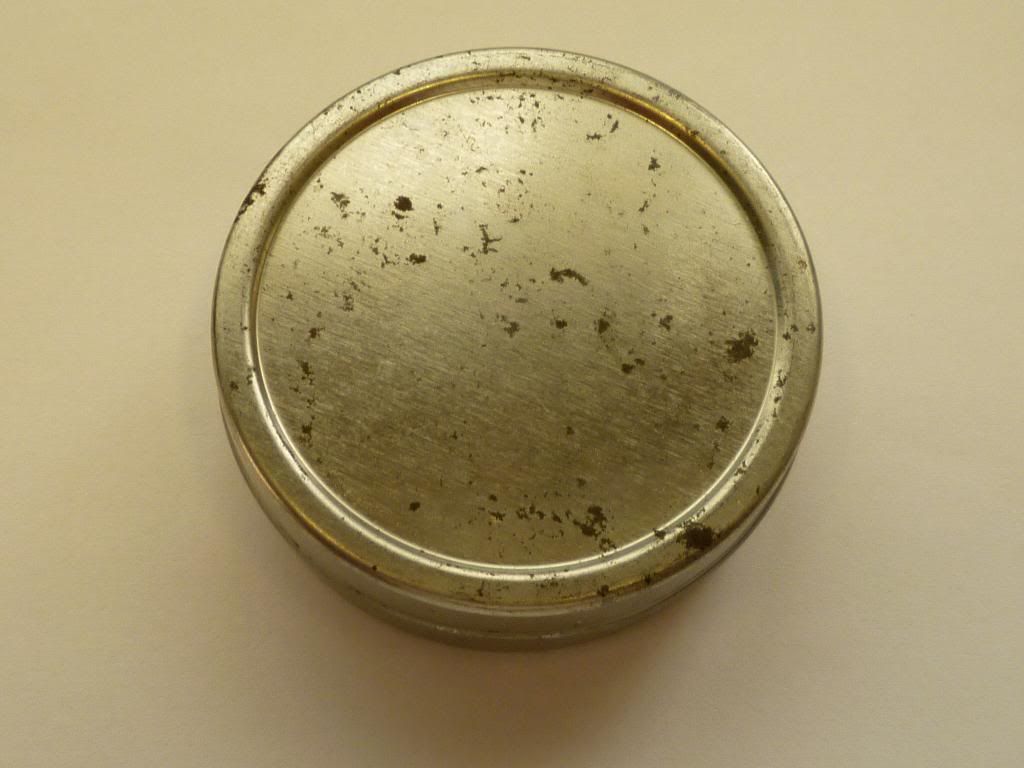
But Roun(d) Tuits aren't neccessarily all quite so elaborate nor inscribed - and frequently don't keep time. This
Bit scabby innit ? | |
| ||
 Site Owner Posts: 14428 |
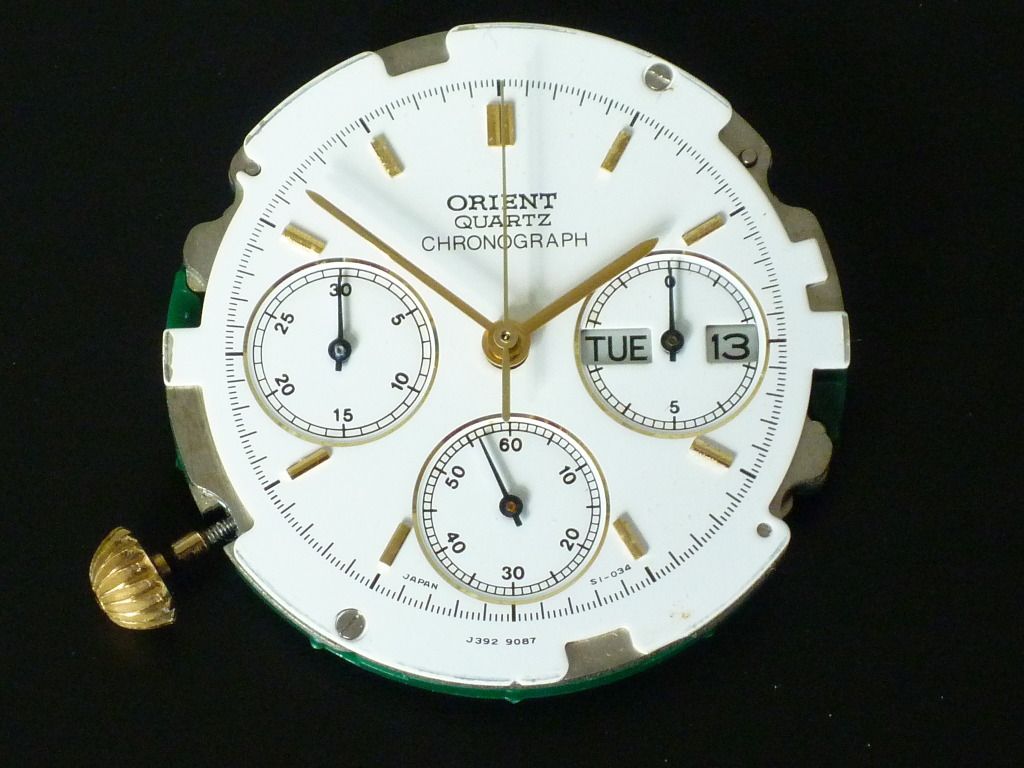
Inside that little tin box, which may be a bit rusty on the outside, but is spotless inside, for nearly two years (hence the 'Round Tuit') .... has languished a complete Seiko 7A38 movement - or more correctly, in this particular case, an Orient J3920 branded movement. It's been soaking, dial side up, in a couple of millimeters of WD-40, which for the first couple of months, I regularly topped up. The abbreviation in the title: B.A.D. stands for Battery Acid Damaged. No doubt, some of you will instantly recognise which movement I'm referring to. I've posted the odd photo of it on this forum before. But I first wrote about it here on RLT, on page 7 of the Orient J39 thread, back in November 2011. (My posts #'s 102 and 103). | |
| ||
 Site Owner Posts: 14428 |
The photos in the RLT thread have long since gone missing - after I'd re-named / re-organised my Photobucket account. But for the benefit of those who haven't seen them in other threads, here they are again, interleaved with original text from my two posts on RLT: But worse was to come, when I unscrewed the case-back: http://i640.photobucket.com/albums/uu124/P4Replica/Orient-J39908-70-Gold-WhiteFace-P1050820.jpg
This is probably the worst example of battery acid damage to a 7Axx movement that I've ever personally encountered .... Though from memory, DaveS had a much worse-looking 7A28 - although I can't find the particular photo at the moment. http://i640.photobucket.com/albums/uu124/P4Replica/Orient-J39908-70-Gold-WhiteFace-P1050926.jpg
Doesn't look any better in a bright light: http://i640.photobucket.com/albums/uu124/P4Replica/Orient-J39908-70-Gold-WhiteFace-P1050925.jpg As you can see, the acid gunge had run right around the movement, virtually destroying everything in it's path. Not only that, but the battery has welded itself to the back-plate, which will make that very difficult to rescue.
Before I popped the movement out, I'd already tried very tentatively turning the main hands using the crown. The sweep second hand moved around with the minute hand, instead of staying static, as you'd expect. The date would click over manually, but the day wheel stayed resolutely stuck on DOM.
The simple reason for the former was that the acid damage / rust had permeated right up through the central hand stack: http://i640.photobucket.com/albums/uu124/P4Replica/Orient-J39908-70-Gold-WhiteFace-P1050924.jpg ------------------------------------------------------------------------------------------------------------------------------------------------------------------------ As you can see from the second photo in the previous post .... From the sheer amount of rust and gunge which also pooled in the inside of the case-back, it would appear that the watch was left for years in a drawer with an old battery, luckily face up. I suspect that the leaking acid running up through the central hand stack was by capilliary action. So, other than some oxidization to the batons and hands, the dial itself survived reasonably well undamaged. There is also a very small localized amount of paint micro-blistering - but it's almost invisible to the naked eye. I've put the original Orient movement to one side, for the time being, and will see what I can rescue from it at a later date. In the meantime, I fitted the dial and hands to a spare rebuilt Seiko 7A38 movement (one with a Spanish DOM day wheel) .... ------------------------------------------------------------------------------------------------------------------------------------------------------------------------- * Something I omitted to point out was that the same problem existed with the 30 minute gearing (adjacent to THU on the day wheel). In fact, if you look at the state of the collets of the original Orient sub-dial hands, which I re-used on the rebuilt Seiko 7A38 movement (and may have inadvertently fitted on different spindles to their original positions - the rustiest of them is now at constant seconds) .... Probably all 3 sub-dial gear trains had been affected to some extent:
| |
| ||
 Site Owner Posts: 14428 |
When I did subsequently get round to looking at the B.A.D. Orient J3920 movement, initially at least, it was pretty apparent it wasn't going to come apart easily. If I remember, I could only unscrew one of the seven back-plate screws at the time. The rest were solid. So, I squirted a couple of cc's of WD-40 from an aerosol into the bottom of that little tin, so that it was a couple of millimeters deep, plopped the movement in, put the lid on and left it. And left it .... After maybe a year, I had another look at it and tried a couple more screws and managed to get another one out. Then, some time later, I managed to undo the rusty screw on the battery positive plate. I gingerly levered that out, followed by the battery, which surprisingly came out - without taking a chunk of the back-plate with it. Another top up of WD-40 followed. Then I conveniently forgot about it; the tin got hidden under a pile of other stuff on my bench. I'd last mentioned it here, in another thread about my NOS Orient J39908-70, back in December last year, where I wrote: You may possibly be wondering what became of the original battery acid-riddled Orient J3920 movement. Well, more than a year later, it's still soaking in a shallow pool of WD40 in a small metal tin. Realistically, all I ever expected (or hoped) to save from it was the Orient J3920 stamped backplate. So far, I've actually managed to get 4 of the 7 screws undone - without having to resort to drilling them out ! If you've read the Racer J39 thread, then you'll know I bought a Racer branded version of the same Orient J39908-70 recently. It may have looked in nice cosmetic condition, externally at least, apart from the hands, but I was extremely p!ssed off to discover the original Orient J3920 stamped movement had been replaced by a rusty secondhand Seiko 7A38 movement ! Which is what reminded me .... | |
| ||
 Site Owner Posts: 14428 |
The following is a testament, not to my persistence, but to what wonderful stuff WD-40 is. It really does just like it says on the can:
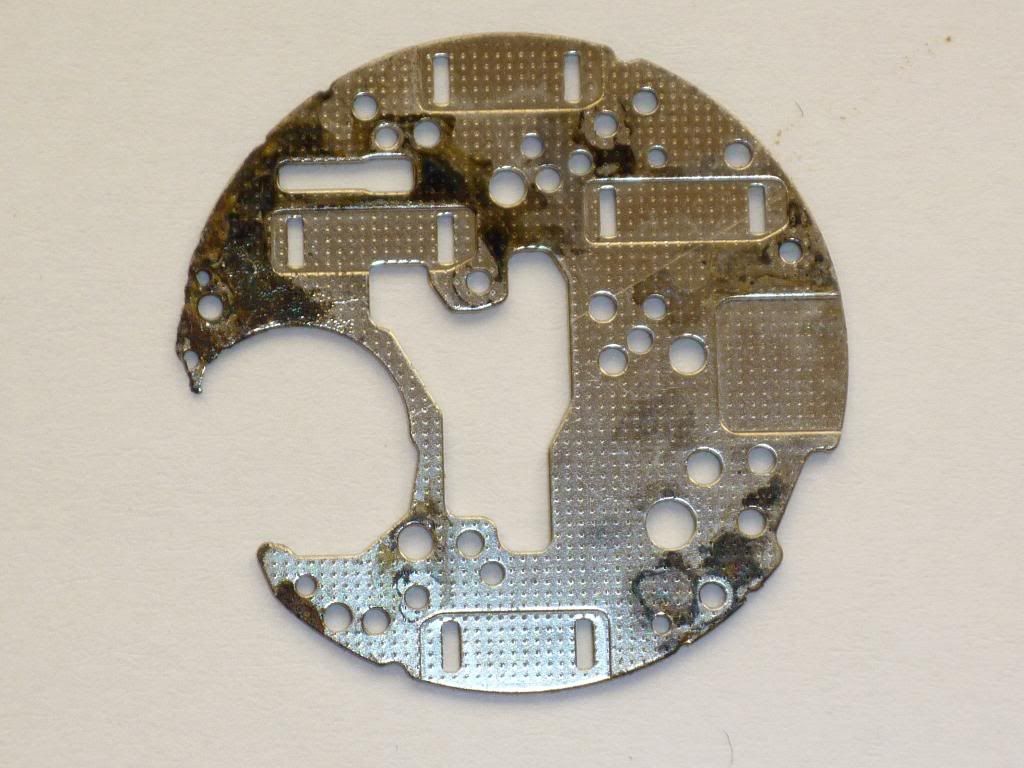
All I'd ever really expected to save from this B.A.D. movement, if I could get it apart, were the bridges and maybe the back-plate. But I knew in my heart of hearts that I'd probably have to end up drilling out or grinding away that very rusty screw nearest the battery. Anyway, yesterday evening I decided to have one more go at it, so I dug out the little tin; ground a new edge on a 1.4mm screwdriver, and proceeded to undo the remaining 3 screws, including the one I'd been dreading for all this time ! I've since cleaned up the back-plate a bit more, scraping gently away at the rust and gunge with a couple of wooden cocktail sticks:
The underside is still pretty much in the same condition as I removed it:
| |
| ||
 Site Owner Posts: 14428 |
So with that kind of battery acid damage on the rear of the back-plate you'd expect the PCB to be completely toast, right ? So did I. However, I peeled it off the back-plate very carefully - messy job, because it was a bit gloopy from soaking in WD-40. I've since been cleaning it up with cotton buds, alternating with squirts of this stuff, an alcohol-based solvent cleaning fluid.
Not bad, eh ?
| |
| ||
 Site Owner Posts: 14428 |
The '710' green plastic insulator spacer came off easily enough, doesn't seem any the worse for being soaked in WD-40 for 18 months plus, and after an overnight soak in neat Flash, followed by a quick scrub with an old toothbrush, this morning, looks almost like new:
| |
| ||
 Site Owner Posts: 14428 |
But the biggest surprise was the condition of the movement I found underneath the '710' spacer.
The photo isn't out of focus. That blurriness is the gloop deposits left by the WD-40. There's very little evidence of rust visible, except on the screw head / coil block, nearest the battery well. Most of the threads inside the back-plate stand-off posts look pretty dark, too. To quote the late great Magnus Magnusson: I've started so I'll finish .... I don't actually intend to rebuild this movement. It's going to take a long time to strip and clean the components properly, for one thing. But I plan to clean up that Orient J3920 stamped back-plate, and re-install it in my original 'beater' Orient J39908-70, where it belongs. Heck, I may even try the PCB in there, while I've got the back-plate off ! The rest of the components will eventually find their way into my used spare movement parts box - for later possible re-use .... Separately bagged, suitably labelled as B.A.D. I'll add a few more photos of anything interesting (like the state of the shaft of the centre seconds wheel) as the strip-down proceeds. | |
| ||
 Member Posts: 458 |
My money says that PCB won't work. It looks like it should, so it won't!!! ................... | |
| ||
 Site Owner Posts: 14428 |
One final very sobering thought for now. Remembering how bad the back-plate of this Orient J3920 movement looked when I first saw it, and how well it has cleaned up so far. Next time you see Filipino arch-watch-botcher Ramoncito Bangit (a.k.a. Badingski on eBay) include a photo of a movement like this ....
(from his eBay listing for a gunmetal / gold two-tone 7A34-7010 in November 2012 - item # 271101265965, re-sold by Timely_Classic)
.... Think what it may have looked like BEFORE he 'restored' it. Be VERY afraid. Run away !! | |
| ||
 Site Owner Posts: 14428 |
Remembering how bad the back-plate of this Orient J3920 movement looked when I first saw it, and how well it has cleaned up so far. Took a while to get rid of the rust staining; I reckon this is about as good as I'm going to achieve, without resorting to a buffing wheel:
In fact, although I was careful to avoid reflections / over-lighting in this photo, it's already a lot shinier than when it left the factory. | |
| ||
 Site Owner Posts: 14428 |
Some folks say I'm crazy. Realistically, all I ever expected (or hoped) to save from it was the Orient J3920 stamped backplate. So out with the old 'incorrect'. I'd forgotten how rough-looking the Seiko movement's back-plate I'd previously fitted as a 'quick fix' was.
Heck, I may even try the PCB in there, while I've got the back-plate off ! Just to see if it would still work, back in with the watch's original B.A.D. PCB.
But I plan to clean up that Orient J3920 stamped back-plate, and re-install it in my original 'beater' Orient J39908-70, where it belongs. .... and finally back on with the original 'correct' Orient J3920 back-plate, suitably re-furbished:
| |
| ||
 Site Owner Posts: 14428 |
A Fiver wasn't it, Simon ?
Full functionality, first time. | |
| ||
 Member Posts: 508 |
Very nice work you've done there, Paul, congrats! It gives me hope for my 7A38-7060 I bought as a guinea pig, which has almost the same damage on the PCB your Orient had, only that mine had a close encounter with H2O... This was the condition of the back side of the PCB when I disassembled the movement:
I do fear, though, that in my case I will not be so lucky... The front side of the PCB is cleaner...
Think there is hope still?
| |
| ||
 Site Owner Posts: 14428 |
Looking at your PCB, and the fact that it was Water that caused its demise, George - somehow I doubt it. The only easy way to fully test any such 'suspect' electronic components, like my B.A.D. PCB, is to try them in another known good working movement. Sometimes you get lucky, as I did with those parts from my Orient J3920 movement. Better result than expected. Your posting about a water-damaged 7A38-7060 reminded me: I'd actually bought such a watch, deliberately, in April 2011, on eBay Germany. According to my records, I paid 17.50 Euros for it (it came in a job lot with another Seiko). Here's the seller's listing photo:
Can't remember if it was actually described as 'water-damaged', but it it was definitely being sold as a non-runner. I only wanted it for the bracelet (I think I was short of adjustment links at the time). Both the (over-long) spring bars fitted had been butchered, so I ended up having to drill them out, through the gaps in backs of the bracelet end pieces. The watch had obviously suffered from water ingress. Here's the inside of the case:
I'd removed the hands and dial, which had water marks around the periphery, some time ago (note the rusty dial feet screws):
Someone had obviously had a go at it before me, and the seller listing it on eBay, because the screw nearest the battery is broken off:
This is another of those 'Round-tuit' movement projects. Perhaps I ought to drop it in my little pot of WD-40 and leave it for a year ! | |
| ||
 Member Posts: 508 |
Well, yours is in quite better condition than mine, so I guess that even after a few (!) months, it will be up and running... Regarding mine, well, you were right: I tried the PCB on a working movement, and guess what... dead as a dodo... | |
| ||




 *
*


 4th line down: Loosens Rusted Parts (eventually)




 .... A testament to the ultimate recoverability and resilience of the Seiko 7Axx movement.

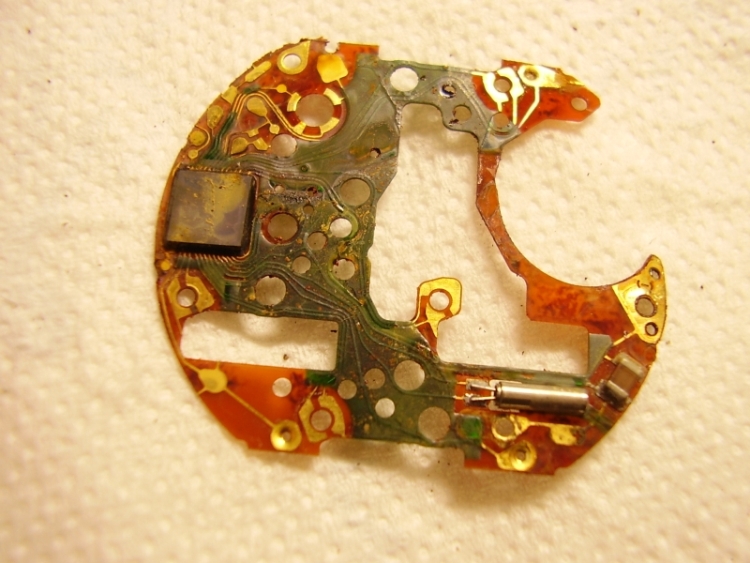


 Removing some rust from the back, prior to installing it, I noticed some tracks were exposed. I tried nevertheless, but no luck. Well, I'll keep it only as a reminder.
 You must login to post.