


Photographers, a macro question.

Psychophysiological entity
Thread Starter
Join Date: Jun 2001
Location: Tweet Rob_Benham Famous author. Well, slightly famous.
Age: 81
Posts: 4,912
Photographers, a macro question.
On the Seiko web site, they have some stunning macro photography. I can't invest much in hobbies right now, but I wondered if I could adapt my beautiful Pentax Spotmatic 1:1.4 lens via a M42 macro adapter.
I don't care about the automation, just the nearness and the quality. Any advice?
Topic: Main plate repair - Seiko 7A38 - by the numbers
Better still
Topic: We're going in ........ deep inside the 7Axx - Seiko 7A38 - by the numbers
I don't care about the automation, just the nearness and the quality. Any advice?
Topic: Main plate repair - Seiko 7A38 - by the numbers
Better still
Topic: We're going in ........ deep inside the 7Axx - Seiko 7A38 - by the numbers

Join Date: Jan 2008
Location: There and here
Posts: 2,080
I can't offer much in the way of advice of converting your camera, but for good macro shots you'd better have a technique or the results will be less than pleasing (out of focus/blurred etc). The modern cameras of today can accomplish a great many things, especially with auto-focus and image stabilisation, yet if the shot hasn't been thought about with regards to light/indoors/outdoors/handshake it will negate said technical wizardry.
SHJ
SHJ

Hippopotomonstrosesquipidelian title
Join Date: Oct 2006
Location: is everything
Posts: 1,823
In the absence of any more info, the answer is "yes". Since you say "spotmatic" we're talking old kit, so I guess you have the Takumar 50 mm. Check the top pic SMC/S-M-C/Super Takumar 50mm F1.4 Reviews - M42 Screwmount Normal Primes - Pentax Lens Reviews & Lens Database.
Join Date: Oct 1999
Location: Swindon, Wilts,UK
Posts: 563
Not sure if the M42 adaptor will work but you can get "filter lenses" which will thread onto the existing lens if it has a filter thread on it. We use close up sets with X1 X2 and X4 lenses which can be combined to give some good results.
We also We use Leica Mono zoom and Navitar close up lenses on our kit. The Navitar lens will, with all the amplifier lenses go down to just over a micron resolution so really needs to be stable.
For this kind of work you need to have a decent tripod preferably with a rack and pinion adjuster on the centre post and a focus rail at least. If not it's impossible to get the camera to the proper focus distance and keep it steady enough to take a decent image.
We also use Fibre Optic lights to be able to get enough illumination on the target without melting the lens or setting fire to stuff.
We also We use Leica Mono zoom and Navitar close up lenses on our kit. The Navitar lens will, with all the amplifier lenses go down to just over a micron resolution so really needs to be stable.
For this kind of work you need to have a decent tripod preferably with a rack and pinion adjuster on the centre post and a focus rail at least. If not it's impossible to get the camera to the proper focus distance and keep it steady enough to take a decent image.
We also use Fibre Optic lights to be able to get enough illumination on the target without melting the lens or setting fire to stuff.
Join Date: Apr 2003
Location: Germany
Age: 73
Posts: 1,561
That's very old kit you have there, but you should be able to find a simple set of extension tubes, or a bellows; either one will enable you to do macro shots. Have a look at websites or else ask at a shop selling used camera equipment.
I am sure you will be happy with the quality of the shots after a little bit of practice.
The Spotmatic uses stop-down metering anyway, I think, so that should not be a problem. Otherwise, just stop down to set exposure; set the lens on ƒ1.4 to compose and focus and then close it all the way down to ƒ16 or whatever the biggest number is to measure the exposure and take the shot.
You will need a good tripod because you will want to stop the lens fully down to achieve good depth of field. Then, camera motion becomes a problem due to the slow shutter speed, hence the use of a tripod to hold the camera steady. I don't think the Spotmatic has it, but using "mirror lock-up" is another way to minimize camera motion, along with using a cable release instead of pushing the shutter release by hand.
You might want to read up on "reciprocity failure" because that can cause problems at longer exposures, depending. If you find that your shots are under-exposed, that might be the problem, not the camera's light meter. You can probably find "reciprocity tables" by going on-line to the film manufacturer's website.
"Slow" film (small ASA numbers) will give better detail than "fast" film (big ASA numbers), all else being equal, and you will probably want film that is color-balanced for artificial light, what you will need to use.
A useful trick to keep the subject perpendicular to the lens, to look at it "flat" so to speak, so that the subject is at about the same distance from the lens at all points; that will help when you have low depth of field.
I am sure you will be happy with the quality of the shots after a little bit of practice.
The Spotmatic uses stop-down metering anyway, I think, so that should not be a problem. Otherwise, just stop down to set exposure; set the lens on ƒ1.4 to compose and focus and then close it all the way down to ƒ16 or whatever the biggest number is to measure the exposure and take the shot.
You will need a good tripod because you will want to stop the lens fully down to achieve good depth of field. Then, camera motion becomes a problem due to the slow shutter speed, hence the use of a tripod to hold the camera steady. I don't think the Spotmatic has it, but using "mirror lock-up" is another way to minimize camera motion, along with using a cable release instead of pushing the shutter release by hand.
You might want to read up on "reciprocity failure" because that can cause problems at longer exposures, depending. If you find that your shots are under-exposed, that might be the problem, not the camera's light meter. You can probably find "reciprocity tables" by going on-line to the film manufacturer's website.
"Slow" film (small ASA numbers) will give better detail than "fast" film (big ASA numbers), all else being equal, and you will probably want film that is color-balanced for artificial light, what you will need to use.
A useful trick to keep the subject perpendicular to the lens, to look at it "flat" so to speak, so that the subject is at about the same distance from the lens at all points; that will help when you have low depth of field.
Join Date: Jul 2007
Location: Fife, Scotland
Age: 75
Posts: 247
The main ways of doing it are -
1. buy another lens with macro capabilities
2. reverse the lens and screw it back on with a reversing ring
3. put a set of extension (preferably automatic) rings between the lens and camera
4. put a bellows between the lens & camera
5. put a bellows between the lens & camera but reverse the lens
6. put a longer focal length lens on then reverse your standard lens in front of that
Lenses & adaptors for all of these are available on ebay.
Lots of discussion on the advantages/ disadvantages of the various methods in Flickr, or see
Macro photography - Wikipedia, the free encyclopedia
1. buy another lens with macro capabilities
2. reverse the lens and screw it back on with a reversing ring
3. put a set of extension (preferably automatic) rings between the lens and camera
4. put a bellows between the lens & camera
5. put a bellows between the lens & camera but reverse the lens
6. put a longer focal length lens on then reverse your standard lens in front of that
Lenses & adaptors for all of these are available on ebay.
Lots of discussion on the advantages/ disadvantages of the various methods in Flickr, or see
Macro photography - Wikipedia, the free encyclopedia
Dep Chief PPRuNe Pilot
Join Date: Jan 1997
Location: UK
Posts: 7,461
Simplest solution of all to try out macro is the old lens reversal ring.
It puts your lens on the wrong way around and focuses far closer. The age and simplicity of the Spotmatic really lends itself to this method.
Rob
It puts your lens on the wrong way around and focuses far closer. The age and simplicity of the Spotmatic really lends itself to this method.
Rob

Join Date: Nov 2007
Location: New Zealand
Age: 74
Posts: 508
Hi Mr Rivets, this is with a Pentax DSLR, sorry I dont recall the lens I used with a long extension, a foot or more.

Computer RAM, c1960's.
I am not sure what you are proposing. If you are using a Spotmatic camera, or any camera with M42 lens, and your Pentax lens all you need is a tube to extend the lens away from the camera, there are sets of short macro tubes that screw together or you can get a bit more up market and use a set of bellows which are commonly available used.
If you want to do it yourself a simple length of cardboard or plastic tube between the lens and the camera will get you magnification depending on how long the tube is but this method is somewhat tricky in that you need to eliminate any light reflections inside the tube (mat paint, light baffles etc) and of course everything has to be carefully aligned.
If you are using a camera with non changeable lens I am sorry I dont have any experience of that.
John
Computer RAM, c1960's.
I am not sure what you are proposing. If you are using a Spotmatic camera, or any camera with M42 lens, and your Pentax lens all you need is a tube to extend the lens away from the camera, there are sets of short macro tubes that screw together or you can get a bit more up market and use a set of bellows which are commonly available used.
If you want to do it yourself a simple length of cardboard or plastic tube between the lens and the camera will get you magnification depending on how long the tube is but this method is somewhat tricky in that you need to eliminate any light reflections inside the tube (mat paint, light baffles etc) and of course everything has to be carefully aligned.
If you are using a camera with non changeable lens I am sorry I dont have any experience of that.
John
Last edited by John Hill; 20th Jan 2014 at 18:06.
Resident insomniac
Join Date: Aug 2005
Location: N54 58 34 W02 01 21
Age: 76
Posts: 1,863
For macro photography you need oodles of light.
As has been mentioned your camera is perfect capable - I used older equipment than yours when I was doing macro in the late 1950s/very early 1960s.
Can you still get your films processed?
As has been mentioned your camera is perfect capable - I used older equipment than yours when I was doing macro in the late 1950s/very early 1960s.
Can you still get your films processed?
Join Date: Apr 2003
Location: Germany
Age: 73
Posts: 1,561
We're just trying to keep it simple, Dushan, when ASA is what an old Spotmatic will show; the numbers are the same as for the current ISO; ASA 400 = ISO 400.
DIN won't come into it for a Spotmatic. That's for Leica fetishists, yes?
You should be able to get a set of extension tubes, a bellows, or a reversing ring from a vendor of used equipment for not very much money, and then just take it from there. (I don't think making an extension tube is a very practical idea, because you need to keep the lens perfectly square to the film plane, and the tube must be light-tight.) Such things are cheaper and better than these lenses that fit in front of the normal lens to enable macrophotography. Those are used more for cameras that have the lens fixed to the body, not the case with the Spotmatic.
It's nice to have a copy stand, but not really necessary, especially if it's something small such as a watch that you want to photograph. Bear in mind that the usual tripod will not point the camera straight down, so that you will need the subject on a vertical surface. A plain old desk lamp or two will do for illumination.
DIN won't come into it for a Spotmatic. That's for Leica fetishists, yes?
You should be able to get a set of extension tubes, a bellows, or a reversing ring from a vendor of used equipment for not very much money, and then just take it from there. (I don't think making an extension tube is a very practical idea, because you need to keep the lens perfectly square to the film plane, and the tube must be light-tight.) Such things are cheaper and better than these lenses that fit in front of the normal lens to enable macrophotography. Those are used more for cameras that have the lens fixed to the body, not the case with the Spotmatic.
It's nice to have a copy stand, but not really necessary, especially if it's something small such as a watch that you want to photograph. Bear in mind that the usual tripod will not point the camera straight down, so that you will need the subject on a vertical surface. A plain old desk lamp or two will do for illumination.

Join Date: Nov 2007
Location: New Zealand
Age: 74
Posts: 508
An example shot:

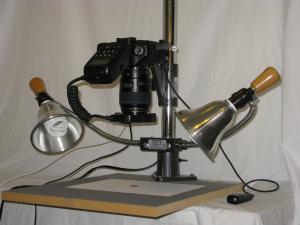
taken with this rig.

The camera is a Pentax K5 and the lens is a Pentax lens which was supplied with the bellows.
The stand is made from an old drill stand attachment and the lighting is a simple arrangement of white(ish) LEDs.
taken with this rig.
The camera is a Pentax K5 and the lens is a Pentax lens which was supplied with the bellows.
The stand is made from an old drill stand attachment and the lighting is a simple arrangement of white(ish) LEDs.
Resident insomniac
Join Date: Aug 2005
Location: N54 58 34 W02 01 21
Age: 76
Posts: 1,863
As has been advised stop down the lens to get the best available depth of field.
Guest
Posts: n/a
Originally Posted by John Hill

That would have been because you did not know its proper name was 'random access memory'.
Guest
Posts: n/a
Chuks, so you think there is still hope for my Gossen Lunasix III? I think it only has DIN markings. Oh and it takes the evil mercury batteries (yes I do have a six page write up on how to adapt the current batteries with miniature resistors, form the mad Swede. Or is he Norvegian).

